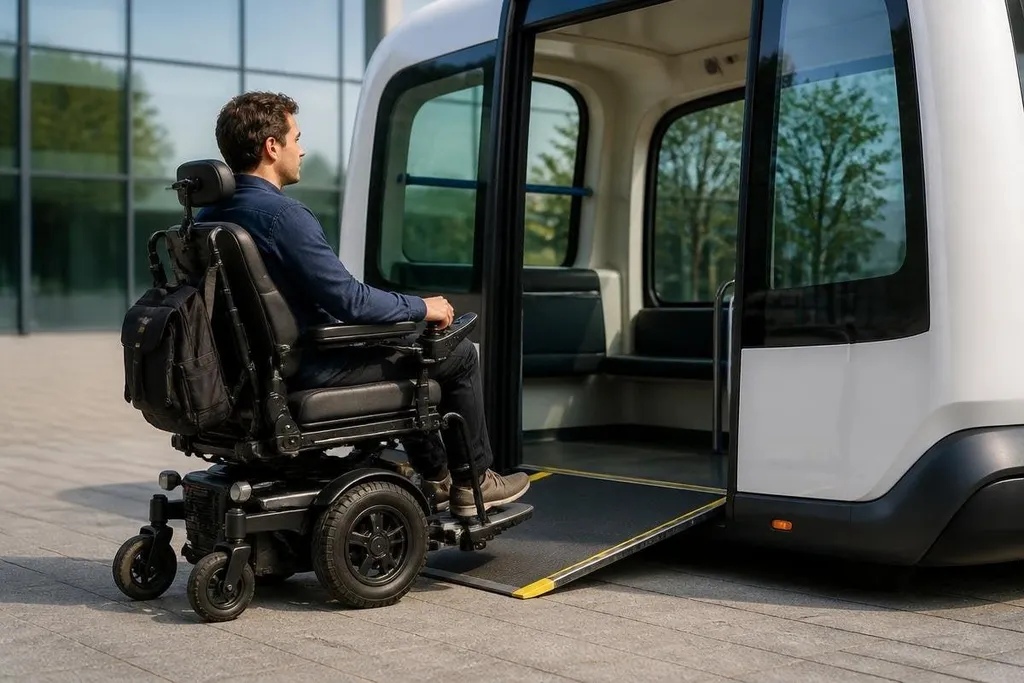
A mobility robot changes travel by taking over part of the work: steering, balancing, lifting a leg, or carrying a person. The clearest examples are powered wheelchairs, robotic exoskeletons, and small autonomous vehicles that move people through buildings or private spaces.
For someone choosing equipment for daily travel, the useful question is practical: which task does the robot handle, and what still needs a human?
- Wheelchair robots can control speed, direction, and braking.
- Exoskeletons can add movement at the hip, knee, or ankle.
- Autonomous carts can carry a passenger along a mapped route.
The work moves from the person to the robot
A standard wheelchair gives the person control through a joystick or push rims.
A powered wheelchair adds motors, a battery, and a control system, so the user can travel without turning the wheels by hand.
A more advanced system can add sensors. LiDAR measures distance with pulses of light, while cameras help the robot identify walls, doors, people, and other obstacles. The control system uses those inputs to adjust speed or stop the motors.
That shift matters when a person has limited strength, balance, or hand control. The machine handles repeated steering and braking, while the rider chooses the destination and decides when to move.
Exoskeletons move the work in a different way. A frame worn around the legs can use electric motors at the joints to help lift and place each foot. The wearer still supplies part of the movement, but the robot can reduce the force needed for each step.
The fit has to be precise. A joint that bends at the wrong time can make walking harder, so these systems need sensors that read body motion and software that responds without a long delay.
Routes become part of the vehicle
A personal mobility robot needs more than motors. It needs a way to know where it is, where it can go, and what has changed since its route was recorded.
Indoor systems may use floor maps, cameras, LiDAR, or markers placed around a building. Outdoor systems face uneven ground, rain, curbs, traffic, and changing light. Those conditions make route planning harder than moving across a clear test floor.
A robot that drives a person to a known room can follow a planned path.
A robot sharing a pavement with pedestrians must react to movement that no map can predict. That is why slow speed, manual controls, and a physical stop button still matter.
Mobility robots need to be judged on the route they can handle, not only on a clean test run. Mobility robot reports from Robot24.com can place speed, route, control method, and test date beside each result before the next section looks at the physical limits that shape every trip.
The limits are physical
Battery weight affects range, lifting power, and comfort. A larger battery can support longer travel, but it also adds mass that the person may need to transport or recharge.
The environment sets another limit. A wheelchair robot may work well on a smooth floor and struggle at a narrow doorway. An exoskeleton may help on level ground but offer little help on stairs unless its control system and mechanical design support that task.
Control is also a human issue. A rider needs a clear way to start, stop, change speed, and take over. If the robot makes a wrong choice, the person must be able to correct it without reaching for a hidden switch or waiting for a remote operator.
Privacy can matter too. Cameras and location sensors may record details about where a person travels. Any system used in homes, care centers, or public buildings needs clear rules for that data.
I’d skip any mobility robot that hides its manual controls behind an app.
A buying check for real travel
Before choosing a system, check the task and the place where it will run:
- Map the route: measure door widths, turning space, ramps, lifts, and surface changes.
- Check the controls: test the joystick, buttons, brake, stop control, and manual override.
- Read the battery details: confirm charging time, battery weight, and the maker’s stated travel range.
- Ask about service: find out who replaces motors, sensors, wheels, or worn joint parts.
- Test the user fit: check seat position, harness contact, joint alignment, and transfer space.
- Set a fallback: decide how the person gets home if the robot stops or loses power.
Mobility robots will change transportation first in places where the route is known and the task repeats. The next useful proof will be simple: how many trips a person can complete safely, without a technician standing nearby.